
The snow monkeys hot springs were one of my biggest Japan highlights. Here’s how (and why!) to visit the Japan snow monkeys in April (or any other month)!
If you love (ethical) wildlife encounters and other ecotourism adventures, the Japanese snow monkey hot springs should be high on your Japan bucket list.
This is especially true if it will be your first time in Japan, but repeat visitors won’t be disappointed.
Even if you’re not usually a fan of safaris and nature-based travel, the snow monkeys hot springs are a completely unique experience unlike anywhere else in Japan (or the world!).
For that reason – and many more – visiting the snow monkeys hot springs is well worth adding to your Japan itinerary, whether you’re there for an extended time like me, or only have 7 days to explore.
If you’re there in the early spring, a visit to the snow monkey park is unmissable. Visiting the snow monkeys in April is quite possibly the best time of all, for the many reasons that we’ll cover in this post.
Here’s your complete guide to where to see snow monkeys in Japan, when to go and how to make the most of your visit.
Just to let you know… This post contains affiliate links, including Amazon Associates links. I may receive a small commission from them at no extra cost to you.
What are the snow monkeys hot springs?
Seeing animals in the wild is always a special experience – and the best way to travel. It’s nearly always a bit of a luck-fuelled mission, too.
So let me give you the good news right now: Getting up close and personal with the snow monkeys in Japan couldn’t be easier.
You’ll have to go on a slight mission (if you count a 30-minute walk through the forest as a mission, that is), but you’re pretty much guaranteed to see lots of these adorable creatures.
In fact, you’ll probably find yourself surrounded by the little guys.
You may even see the cutest newborn babies if you visit the Japan snow monkeys in April! But we’ll get on to that soon… as we’ll see, anytime is a good time to visit the snow monkeys hot springs!
Excited yet? If not, perhaps these guys will change that:


Why are there hot springs with monkeys in japan?
In one part of Japan, the Japanese snow monkeys have cottoned on to one of the Japanese people’s greatest rituals: the onsen.
If that word means nothing to you, let’s pause for a mini Japanese crash course.
An onsen is a natural hot spring used for bathing in Japan. Japan has thousands of onsen and a trip to an onsen town is another must for anyone visiting Japan.
In one onsen, a group of local snow monkeys started using one of the natural hot springs and, in true Japanese politeness, the humans left the hot spring to be a monkey bath.
Now, it’s the only place to see bathing monkeys in Japan – and the world!
What are the Japanese hot spring monkeys called?
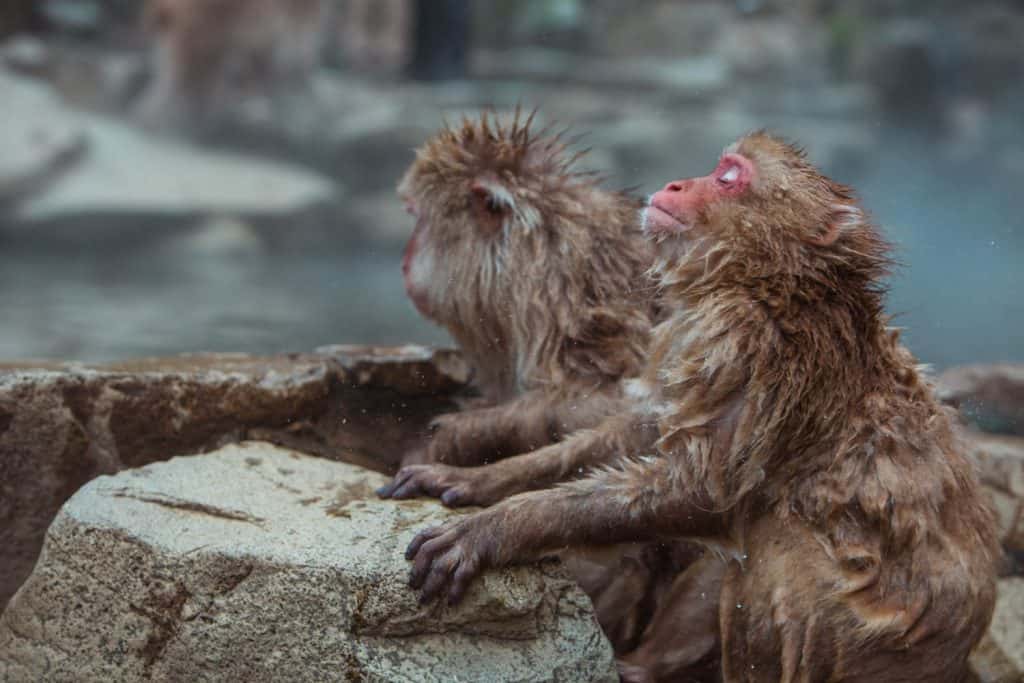
The monkeys that inhabit the famous snow monkeys hot springs are a type of primate known as macaques.
Macaques can be found all over the world – including in Gibraltar and Bali!
The macaques that you can see in Japan are a subspecies of macaque known as the Japanese macaque. They are native to Japan and are the only ones that practice the Japanese tradition of onsen.
For this reason, they are sometimes referred to as the “hot springs monkeys”, but it is more common to hear them referred to as the “snow monkeys” or “Japanese snow monkeys”.
Where to see snow monkeys in Japan
Japanese macaques – or snow monkeys – live throughout Japan, inhabiting three of the country’s main islands.
However, the most famous snow monkeys are of course the ones that use the hot springs at Jigokudani Monkey Park.
Even though many people assume this is in Hokkaido. This can be especially confusing because Hokkaido has its own Jigokudani (Hell Valley), but there are no snow monkeys there because Japan’s northernmost island is actually too cold for them!
Instead, they live in the mountains of Nagano Prefecture, on the main island of Honshu.
Jigokudani Snow Monkey Park
The Jigokudani Monkey Park is in Yamanouchi in the Nagano Prefecture, in the valley of the Yokoyu River.
The nearest town is Shibu Onsen, a cute little onsen town that has several ryokan options for travellers who want to spend the night.
Since these are wild monkeys – and natural hot springs – you do have to venture a little way out of town to see them.
The area they inhabit has been turned into a protected park so that travellers can visit, but the monkeys are still completely wild.
The park is open every day from 8:30am – 5:00pm in the summer and 9:00am – 4:00pm in the winter.
These can change slightly on a day-to-day basis and they are very strict in making sure everybody leaves on time, so allow plenty of time to view the monkeys.
We spent around two hours there in total because, even though the space is small, there were too many cute moments and photo opportunities to miss!
Just remember: these are wild animals and their behaviour can be unpredictable. Make sure you keep personal items hidden, do not bring any food into the park and leave the selfie sticks behind.
DON’T TRAVEL TO JAPAN WITHOUT INSURANCE!
If you only do one thing before your trip to Japan, please make sure you have adequate travel insurance. Make sure your policy covers you for healthcare and cancellations, as well as any activities you plan to do because Japan has some of the most expensive healthcare in the world!
As of 2023, I use and recommend Heymondo because they offer greater cover – they cover things that most insurers won’t – and 24/7 assistance no matter where you’re going (or where you’re from!).
They offer options for single trips, long stays and annual coverage, so they’re a great budget-friendly (yet sufficient) option for digital nomads and frequent travellers, too.
How to visit the monkey hot springs in Japan
The good news is that getting to the monkey park is fairly easy. The bad news is that it won’t be a suitable journey for all visitors.
Since this is a natural habitat in mountain terrain, the ground can be uneven and slippery. If you plan to visit the Japan snow monkeys in April or earlier, it may also be icy.
Therefore, travellers with mobility issues may not find it particularly accessible. All types of dogs, including service dogs, are also banned since they don’t gel well with the monkeys.
In order to enter the park, you will need to purchase a ticket at the ticket office. This is at the park entrance and there is also a small gift shop, and the hot spring pool that the monkeys use is a short walk from here.
When it comes to planning your trip to the monkey park, you have several options. All of them will involve taking the bullet train from Tokyo, Kyoto or another major city to Nagano, so make sure you have a JR Pass.
Spend a night in Yudanaka & Shibu Onsen
If you want to make an early morning start and have the snow monkeys all to yourself, consider spending a night in Shibu Onsen.
Shibu Onsen is a cute little town where humans can enjoy the natural hot springs, before or after seeing the snow monkeys enjoy their own private one!
It may not have the eclectic nightlife of Tokyo or Kyoto, but it will still be a completely unique experience.
This cute town has some of the most eclectic little restaurants I’ve ever eaten at as well as more public hot springs than anywhere we visited in Hokkaido.
Shibu Onsen is the town that most visitors stay in (hence why the monkey park is sometimes referred to as Shibu Onsen Snow Monkey Park) and it’s where we spent the night.
It’s also a great place to tick off three of your Japan travel plans at once. You can stay in a ryokan (a traditional Japanese inn), visit an onsen and see the snow monkeys all in one day!
From Shibu Onsen, Jigokudanai is only a 10-minute bus ride (and a short walk) or a 45-minute walk all the way there. It’s uphill but through an amazing forest, so well worth the trek if you’re up to it.
There isn’t much else to do in Shibu Onsen, so it’s probably best to skip staying here if you only have a short time in Japan, but it’s worth spending a night if you’re travelling slowly or want a quiet retreat away from the big cities.
Top sustainable hotels in Yudanaka & Shibu Onsen:
- Enjoy a private onsen experience: Yudanaka Yasuragi
- Stay in a traditional Japanese ryokan: Yorozuya
- My favourite homestay (with coffee!): Koishiya Ryokan
- Stay close on a budget: Fudoson-no-Yu Oyado Kotobuki
Nagano to snow monkey park
Many travellers choose to visit the Jigokudani Monkey Park on a day trip from Nagano city, especially if they are already planning to spend some nights there.
The easiest way to make this trip independently is by taking the Shigakogen express bus from outside Nagano train station.
It takes around 45 minutes to get to the Snow Monkey bus stop, and the park is a further 40 minutes or so by foot.
Alternatively, you can take the local Nagano Dentetsu train from Nagano to Yudanaka – the same station you’ll travel to if you stay in Yudanaka or Shibu Onsen.
From Yudanaka station, hop on the Kobayashi bus to the Snow Monkey Park bus stop.
The express bus is faster than the train option but bypasses the towns of Yudanaka and Shibu Onsen. The cost of both is about the same, so it’s really down to preference (and timings!).
Hakuba to snow monkeys park
If you are visiting the snow monkeys hot springs from Hakuba, a popular ski town in the Japanese Alps, there is no direct bus to the park.
If travelling independently, you’ll need to travel via Nagao – a journey which takes around two hours each way.
It’ll be much easier to join an organised tour where logistics are taken care of for you. This one includes pick up from several places in Hakuba and also includes lunch, the entrance fee, a personal tour guide and optional sake tasting.
This tour sells out regularly but offers free 24-hour cancellation, so it’s best to book as soon as possible once you know your dates!
Jigokudani Monkey Park from Tokyo
Even though Tokyo may look quite far from the snow monkeys hot springs, it’s easier to get there than you may think!
The JR Hokuriku bullet train from Tokyo to Nagano takes 1 hour 20 minutes, so you can be at Jigojudani Monkey Park in around two hours.
If you don’t have a Japan Rail pass, it costs 8,200 Yen (around $82) each way and there are around four trains per hour.
To save time (and logistical headaches!), you can then join an organised tour from Nagano station and let a private guide take care of the rest.
Alternatively, you can also take a group tour from Tokoyo to see the snow monkeys. This one even ends with a trip to Zenko-ji Temple which is definitely worth seeing.

Can you see snow monkeys in April in Japan?
It’s possible to see the snow monkeys at almost any time of year, although you must keep in mind that there’s no guarantee they will appear.
April tends to be pretty reliable – and also comes with a number of benefits, so visiting the Japan snow monkeys in April is a great idea!
Why visit the Japan snow monkeys in April
I visited the Japan snow monkeys in April and, while I may be a little biased because I had the BEST time there, I really do think it is a great time to go.
For a start, there is likely to still be snow – so you can see the snow monkeys with a powdery white backdrop – yet the temperatures will be much milder than in the cold winter months.
While nothing beats relaxing in the hot spring baths after hiking back from the park, the hike itself is much more pleasant in the warmer months!
Understandably, the winter season is the peak tourist season for visiting snow monkeys. However, you can still enjoy the magical Japan winter during April and also enjoy fewer crowds – something that makes the experience much more magical.
Because of the milder climate, it’s also a safer time to make the hike to the park.
While the snow monkeys may not spend as much time in the hot springs in April as they do in the middle of winter, they’re much more active at this time of year too.
Since spring is birthing season for the Japanese macaques, you may also get to spot some snow monkey babies – the cutest thing of all!
Last but not least, April is a great time to visit Japan in general. Not only will you have a high chance of seeing cherry blossoms in Nagano and other cities, but you can also time it with a visit to Hokkaido.
The Japan Rail Pass
If one thing becomes abundantly clear when planning your itinerary for Japan, it is that the Japan Rail Pass is essential.
This handy little card gives you access to the entire network of high-speed trains (and some non-high-speed local trains) across the country, making it possible to squeeze much more into your time in Japan.
It will also save you a small fortune on the cost of travel in Japan!
It’s best to order your pass before you leave because it’s much cheaper than buying it once you arrive. Plus, it’s also much easier.
You can buy your pass on this official website and get free delivery to almost any country in 24-48 hours. If you prefer, you can also do as I did and pick your pass up when you arrive, but you’ll save time by getting it delivered.
The best time to see snow monkeys if you can’t travel in April
Can’t visit the Japan snow monkeys in April? No worries!
While my personal preference is for April, each season has its own perks.
If you want to see the snow monkeys with a backdrop of snow – when they’re spending the most time in the hot springs – then you’ll want to visit between early December, when Japan has its first snow, and March.
But that’s okay because, despite the cold weather, winter is a fantastic time to visit Japan! Just be warned: this is also when crowds are the biggest.
In the summer season, temperatures soar and it can be too hot for both humans and monkeys. While young monkeys will still be active, older monkeys will spend most of their time relaxing in the shade.
This isn’t always a bad thing – it can make it much easier to get great travel photos!
If you plan to visit in the autumn, you’ll also be in for a treat. Jigokudani Snow Monkey Park will have a beautiful backdrop of autumn colours, and it’s also possible to enjoy these colours elsewhere in Japan.
The only downside to visiting in autumn is that this is snow monkey mating season. Therefore, snow monkeys may not visit the hot springs as much, so it’s best to go a little later in the day to increase your chances of seeing them.
Japan Travel Planning
Even though I found Japan surprisingly easy to travel, it still pays to be prepared.
In fact, it’s one country where you’ll really save yourself some time and money (not to mention stress!) by having as much prepped in advance as possible.
Here is a checklist of things to have prepared before you go:
Shinkansen Tickets
The Japan Rail Pass is a no-brainer for anybody who wants to see more than one part of Japan.
Booking in advance is super simple – much simpler than buying in Japan – AND comes with free 24-48 hour delivery.
I booked through JRailPass.com and can’t recommend them more for their price, efficiency and customer service.
Travel Insurance
The good news: things generally run smoothly in Japan and, when they don’t, the healthcare is some of the best in the world.
The bad news: when things don’t go to plan, it can be very expensive.
That’s why travel insurance is a must in Japan.
Since moving to Portugal, I use and recommend True Traveller because they cover a wide range of activities and circumstances.
If you’re resident outside of Europe, EKTA travel insurance offers affordable, transparent and extensive coverage all over the world.
WiFi/Sim Card
Getting a sim card in Japan is tricky (and expensive!). Unfortunately, I waited until I was there and learned the hard way, so I highly recommend arranging your WiFi situation before you go.
The best way to stay connected while travelling Japan is with an eSim that you can use right away or this local sim with unlimited data that you can pick up on arrival.
Save on flights to Japan
Did you know that you can save up to 10% on flights with a cashback service?
With WayAway Plus, you can find the cheapest flights, transfers and other travel services and receive part of your purchase back in cash. It goes straight to your Paypal account!
I use WayAway to book all my flights so that I can save extra and have secured an exclusive discount for Alajode readers to do the same.
Use this link and the code ‘ALAJODE’ to save a massive 55% on your yearly membership plan and start saving. That mean you’ll get up to 10% off all travel services for less than $4 per month. In just one trip to Japan, that could save you hundreds of dollars!
VPN
Not only does a VPN help protect you and your data while travelling, it can also help you access geo-locked content.
That’s something that comes in really handy in a place like Japan, especially if you don’t speak the local language!
NordVPN is the one I use and trust, and currently has this great deal available.
Airport Transfers
If you’ll be arriving late or staying somewhere fairly remote, consider booking an airport transfer on arrival.
This will take a whole lot of stress out of an already confusing situation when you land in Japan, especially after a long flight.
I’ve found this website has the best prices and the widest availability (sometimes in places where there aren’t even taxis!).
Eeeeeeeek! So cuuuuuuuuute! This is literally the reason I intend to go back to Japan; it’s the one thing I didn’t get to tick of my wish list and it looks amazing!
Cx
Charlie, Distracted